
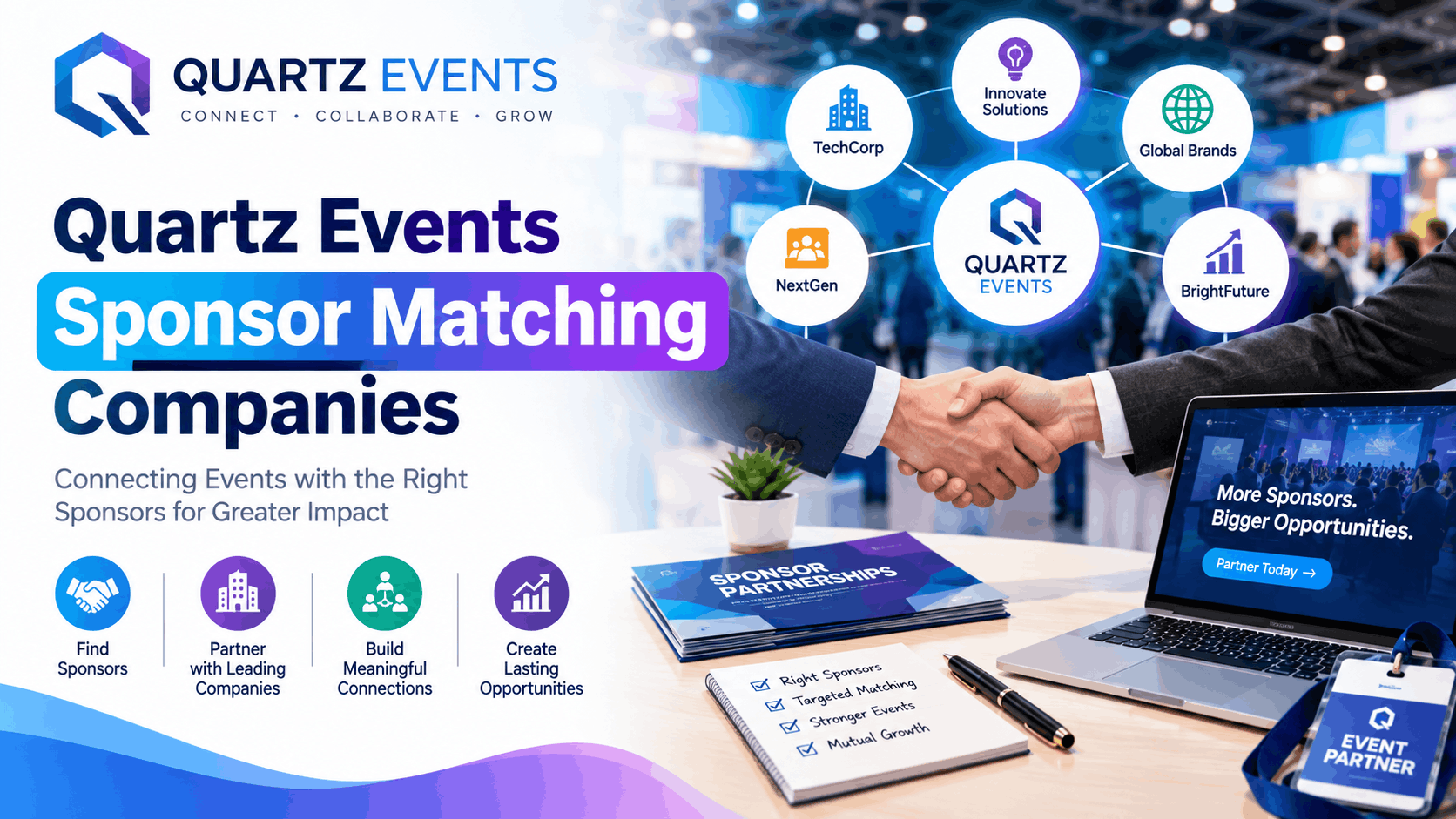
You can have a packed venue, a sharp agenda, and an audience full of decision-makers and still strike out completely on sponsorship, simply because you spent weeks pitching companies that were never going to say yes. That’s the gap quartz events sponsor matching companies are meant to close: instead of guessing which brands might care about your event, matching connects organizers and sponsors based on actual audience fit, industry overlap, and what each side is trying to get out of the deal.
The tricky part is that “sponsor matching” isn’t one fixed service with one fixed process. Depending on the event and the company doing the matching, it can mean anything from an algorithm scoring audience data against a sponsor’s ideal customer profile, to a human consultant making warm introductions based on relationships they already have. Some charge the event, some charge the sponsor, some take a commission on the deal itself and that fee structure quietly shapes whose interests get prioritized.
This guide skips the theory most articles stop at and goes straight to what actually matters if you’re deciding whether to use one of these services: how the matching process really works, what it costs, how long it takes, the specific red flags that separate a useful matching company from a waste of money, and a concrete example of what a good match looks like in practice.
How Quartz Events Sponsor Matching Actually Works
At a basic level, a sponsor matching company sits between event organizers and potential sponsors, using a mix of questionnaires, audience data, and human judgment to connect the two sides. The process usually starts before either party talks to the other the matching company gathers information first, then works to find overlap.
The Intake Call
This is where the matching company learns who you actually are. If you’re an event organizer, they’ll ask about your audience size, industry mix, seniority level, and past sponsors. If you’re a business looking to sponsor, they’ll ask about your target customer, budget range, and what kind of exposure you’re hoping to get brand awareness, lead generation, or direct sales conversations. The quality of this call matters more than most people expect; a rushed 15-minute intake tends to produce weaker matches than a thorough one.
The Matching Algorithm (and Its Limits)
Most matching companies use some form of scoring system that compares event audience data against a sponsor’s ideal customer profile. This can genuinely save time by ruling out obvious mismatches a children’s toy company being matched with a cybersecurity conference, for example. But algorithms are only as good as the data feeding them, and self-reported audience numbers aren’t always accurate. Treat algorithmic matches as a shortlist to investigate, not a guarantee.
The Introduction Stage
Once a match looks promising, the matching company typically facilitates an introduction sometimes a group email, sometimes a scheduled call. From here, the actual negotiation (package pricing, deliverables, exclusivity terms) usually happens directly between the event and the sponsor, with the matching company stepping back or staying involved depending on their business model.
Research Dossier for Target Company: A Practical US Playbook
What It Costs: Fees, Commissions, and Who Actually Pays
This is the question almost no article on this topic answers clearly, and it’s often the first thing people want to know.
Flat-Fee Models
Some matching companies charge a flat fee either to the event organizer, the sponsor, or both for access to their network and matching service. This might be a one-time fee or a subscription-style charge for ongoing access. Flat fees tend to appeal to organizers who want predictable costs and don’t want their sponsorship revenue eaten into by a percentage cut.
Commission-Based Models
Other companies work on commission, taking a cut of the final sponsorship deal once it closes. This aligns their incentives with getting you a bigger deal, but it also means they may push harder for higher-value matches even if a smaller, better-fit sponsor would actually serve the event better. If you’re an event organizer, it’s worth asking directly: does this company get paid more if I say yes to a bigger sponsor, even if that sponsor isn’t the best fit for my audience?
A practical tip most guides skip: ask who pays the fee before you ask what the service includes. If sponsors pay the matching company’s fee, that company’s real client the one they’re incentivized to keep happy is the sponsor, not the event. That single fact changes how you should read every recommendation they make you.
Sponsor Matching Company vs. DIY Outreach: Which Wins?
Neither approach is universally better it depends on your time, network, and event size.
DIY outreach works well when you already have some industry relationships, a clear sense of who’d want to sponsor you, and the time to do the research yourself. It costs nothing but time, and you keep full control over who you approach and how.
A matching company makes more sense when you’re entering an unfamiliar industry, don’t have existing sponsor relationships, or simply don’t have the bandwidth to research and cold-email dozens of businesses. The trade-off is cost (whether fee or commission) and, in some cases, less control over which sponsors get suggested to you first.
A reasonable middle ground many organizers use: try DIY outreach for your top 5–10 dream sponsors the ones you already have some connection to and use a matching company to fill in the rest of your sponsor list.
Tozymagazine.com Trending Explained: A 2026 User Guide
How Long Matching Takes, From Signup to Signed Deal
Timelines vary a lot depending on event size and industry, but a rough shape looks like this:
- Intake and setup: a few days to a week, depending on how quickly you provide audience data and goals
- Initial matches: typically within one to two weeks of a completed intake
- Introductions and early conversations: another one to three weeks, since sponsors usually need internal budget approval before committing
- Final agreement: can take anywhere from a few weeks to a couple of months, especially for larger sponsorship packages that need sign-off from multiple people on the sponsor’s side
If your event is happening soon, it’s worth being upfront with the matching company about your deadline. Rushed sponsor matches are more likely to be mismatches, since neither side has time to properly vet the other.
Red Flags That Signal a Matching Company Isn’t Worth It
Not every sponsor matching company operates the same way, and a few warning signs are worth taking seriously:
- Vague or shifting fee structures. If you ask how they get paid and the answer changes depending on who’s asking, that’s a problem.
- Pressure to sign quickly. A legitimate matching relationship should survive you taking a few days to think it over or check references.
- No verifiable past matches. Ask for even one or two examples of sponsorships they’ve facilitated. A company that can’t point to anything concrete — even anonymized may be newer or less established than they present themselves as.
- Audience data you can’t verify. If a matching company hands sponsors your audience numbers without letting you confirm what’s being shared, that’s worth pausing on. Sponsors will eventually ask you to verify those numbers directly anyway, so it’s better to know upfront what’s being represented on your behalf.
- One-size-fits-all sponsorship packages. If every match comes with the same generic tier structure regardless of event size or industry, the “matching” may be more automated and less thoughtful than advertised.
None of these alone is necessarily disqualifying, but two or more together are a reasonable signal to look elsewhere.
A Real Example: What a Successful Sponsor Match Looks Like
To make this concrete, here’s an illustrative scenario based on how these matches typically play out (not a specific real company, but representative of common outcomes):
A mid-sized regional business conference with around 800 attendees, mostly mid-level and senior professionals in the logistics and supply chain industry, works with a matching company to find sponsors. Instead of targeting large national brands, the matching company identifies three regional logistics software companies whose ideal customers closely overlap with the event’s attendee list.
One of these companies signs on for a mid-tier sponsorship package that includes a speaking slot and booth space, in exchange for a fee in the low five figures. The sponsor gets direct access to decision-makers at target companies; the event gets funding and a credible partner whose product is genuinely relevant to attendees rather than a bigger-name sponsor whose product nobody in the room would actually buy.
The lesson here isn’t the dollar figure it’s that the best fit outperformed the biggest fit, which is the outcome good matching should be optimizing for.
TechTrendery.com USA Review 2026: What the Site Actually Covers
Sponsor Matching for a 200-Person Meetup vs. a 5,000-Person Conference
Event size changes what “good matching” even means. For a 200-person meetup, sponsors are usually looking for close, high-quality engagement with a niche audience — think a local software meetup where a handful of specific companies would genuinely want to talk to the exact people in the room. Matching here should prioritize precision over reach, and small, targeted sponsorships (sometimes just covering venue or catering costs) are common.
A 5,000-person conference operates differently. Sponsors at this scale often care as much about brand visibility and volume of leads as they do about precise audience fit, and sponsorship packages tend to be tiered (platinum, gold, silver) with escalating benefits. Matching companies working at this scale typically need broader sponsor networks and more sophisticated data to justify higher-value packages.
If you’re a smaller event, it’s worth asking a matching company directly whether they have experience with events your size a company whose main network is large national brands may not have the right contacts for a niche 200-person gathering.
Three Alternatives to Quartz Events Worth Comparing
Before committing to any single sponsor matching company, it’s worth understanding the general categories of alternatives available:
- General-purpose event sponsorship marketplaces — platforms where events list themselves and sponsors browse independently, without a matching algorithm doing the work for you. These tend to be cheaper but require more effort on your part.
- Industry-specific matching services — smaller, more specialized companies focused on one sector (tech, nonprofit, healthcare, etc.), which can produce tighter matches than a general platform but with a smaller pool of options.
- Sponsorship consultants — individuals or small agencies who do matching more manually, often combining it with proposal writing and negotiation support. More expensive, but useful if you want hands-on help beyond just an introduction.
The right choice depends on how much of the process you want to own yourself versus hand off.
Contract Terms You Should Never Skip Before Signing
Whatever matching company or sponsor you end up working with, a few contract details are easy to overlook but important to nail down:
- Exclusivity clauses — does the sponsor get category exclusivity (no competing sponsors), and for how long?
- Cancellation and refund terms — what happens if the event is postponed or the sponsor pulls out?
- Deliverable specifics — exact logo placement, mention frequency, booth size, speaking time, spelled out rather than left as general promises
- Data usage terms — what happens to attendee data shared with the sponsor after the event ends?
Getting these in writing before the event, not after, avoids the majority of sponsorship disputes.
FAQ: Quick Answers on Quartz Events Sponsor Matching
Does the event or the sponsor usually pay the matching fee?
It varies by company some charge the event, some charge the sponsor, some charge both. Always confirm this upfront, since it affects whose interests the matching company is really serving.
Can a small event realistically use a sponsor matching service?
Yes, though smaller events should look specifically for matching companies with experience at their scale, since some services are built primarily for large conferences.
How many sponsor matches should I expect from an initial round?
This varies widely, but a handful of well-vetted matches is generally more useful than a long list of loosely relevant ones.
Is it normal to negotiate directly with the sponsor after being matched?
Yes — in most models, the matching company facilitates the introduction, and the actual deal terms are negotiated directly between event and sponsor.
The Takeaway
The real value of a sponsor matching company isn’t the introduction itself it’s whether the match actually fits your audience, and whether you understand the fee structure well enough to know if the company’s incentives are aligned with yours.
Before signing anything, ask directly who pays, ask for a past example, and don’t mistake a bigger sponsor for a better one.
