

Picture a colleague who says “that’s fine” while their jaw does something alarming. The words come out, but only just, as if the lips had been told to keep the door almost shut. English has a word for that voice, and hardly anyone knows it.
Dentiloquent is an adjective meaning speaking with clenched teeth. That’s the short answer. The longer one involves Latin, a noun that dates back to 1737, a few dictionaries that stay silent, and an honest question about whether you should ever say it out loud.
You will probably never need this word. Here is why you will want it anyway: it squeezes a whole stage direction into four syllables.
What dentiloquent means
The word describes speech delivered through closed or clenched teeth. The Phrontistery, a vocabulary site that collects English words built on -loquent, -loquence and -loquy, lists it with exactly that gloss.
The definition is about the mouth, not the mood. In practice, though, nobody clamps their jaw to read a bedtime story, so the word tends to carry a charge: strained politeness, suppressed temper, someone working hard not to say the next thing. That charge comes from how people behave, not from any dictionary.
A quick original example: “Thanks for the feedback,” she said, in a dentiloquent murmur that ended the meeting.
Does it always mean angry?
No. The word names a physical manner of speaking, and context supplies the emotion. A clenched-jaw “fine” in an argument reads as held-back anger. The same delivery from an actor playing a controlled, dangerous character is a deliberate choice. If you want anger on the page, say so, rather than asking one rare adjective to carry both the sound and the feeling.
Dentiloquent pronunciation: how to say it
The most natural reading is den-TIL-uh-kwunt, roughly /dɛnˈtɪləkwənt/ in IPA, with the stress on the second syllable. That’s reasoning by analogy with grandiloquent, because I found no audio pronunciation in a major dictionary. Treat it as a sensible guess, not a ruling.
The noun is easier to pin down. A word-of-the-day blog respells dentiloquy as den-til-oh-kwee. In both words the “qu” sounds like “kw,” as in quick.
Where the word comes from
Two Latin pieces do all the work. Dens (genitive dentis) means tooth, and loqui means to speak. Etymonline traces them further back to Proto-Indo-European roots: *dent- for tooth and *tolkw- for speak. Wiktionary gives the same Latin pair for dentiloquist.
Breaking down dens + loqui
- denti-: tooth, joined on with the linking vowel -i- that Latin compounds like
- -loqu-: speak
- -ent: the adjective ending, roughly “doing the thing,” as in grandiloquent
The first two parts are verified. The third is my reading of how English -loquent adjectives work, an inference from word formation.
Both roots are busy. Dens gives English dental, dentist, denture, indent and trident, and dandelion too, from the French dent de lion, “lion’s tooth.” Loqui gives colloquy, soliloquy, locution and loquacious, plus the delightful somniloquy, talking in your sleep.
A quick way to remember it
Denti = tooth, as in dental. Loquent = speaking, as in eloquent. Tooth plus speaking gives speaking through the teeth.
Dentiloquy, dentiloquist and the adjective
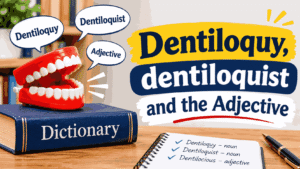
Three related forms share one root:
- dentiloquent (adjective): speaking with clenched teeth
- dentiloquy (noun): the habit or practice of speaking through the teeth, tagged rare by Wiktionary
- dentiloquist (noun): someone who speaks through clenched teeth, also tagged rare
Etymonline dates dentiloquy to 1737. A word-of-the-day blog says it was first recorded in 1913. Those two sources disagree, and I couldn’t open the OED to referee, so I’m going with the earlier Etymonline date and flagging the conflict rather than hiding it.
The noun forms have the stronger paper trail. The adjective rests on Phrontistery and a handful of vocabulary lists. I found no listing for dentiloquence or an adverb form, so treat those as coinages if you meet them.
Is dentiloquent a real word?
Yes, with an asterisk. It has been recorded, defined and built from legitimate Latin parts, and the noun dates back centuries according to Etymonline, so it isn’t an internet invention. It is also uncommon, and you won’t meet it in a newspaper.
What I found: Phrontistery lists the adjective, while Wiktionary-derived data and Etymonline cover dentiloquy and dentiloquist. What I did not find was an entry for the adjective in the Merriam-Webster or Collins pages I looked at. The nearest neighbor there is dentilingual, a phonetics term for sounds made with the tongue against the teeth, which is a different word entirely. The OED sits behind a subscription, so I can’t tell you what it says.
Some pages online say Collins lists this word in its New Word Suggestion section. Collins does run a public-submission program, but I couldn’t confirm that this word appears in it, and a suggestion page isn’t the same as a dictionary entry. Treat that claim as unverified.
One more warning: at least one site claims the word is now used in AI sentiment tools to detect burnout. I found nothing to support that. The word is a curiosity, not a metric.
Dentiloquent vs grandiloquent, magniloquent and other -loquent words
The -loquent family is big. Philology alone collects 54 words of this kind, all built on Latin loqui. Most describe the style or effect of someone’s talk. A few describe something else. Here are the six you’re most likely to confuse:
| Word | Meaning | Root | Tone or typical use |
|---|---|---|---|
| dentiloquent | speaking with clenched teeth | dens (tooth) + loqui | tense, restrained; fiction and word-lovers |
| grandiloquent | pompous, lofty speech | grandis (great) + loqui | mocking; windy speeches |
| magniloquent | high-flown, elevated speech | magnus (great) + loqui | formal, often a little ironic |
| blandiloquent | smooth, flattering speech | blandus (smooth, flattering) + loqui | wry; salesmanship and flattery |
| eloquent | fluent, forceful, persuasive | ex (out) + loqui | genuine praise; everyday |
| loquacious | talkative | loquax, from loqui | mild teasing; everyday |
Look — the easiest way to keep these straight is to ask what each word is describing. Grandiloquent, magniloquent, blandiloquent and eloquent judge the words and their effect. Loquacious counts how many of them there are. This one is the physical kind: it’s about the mouth. A few relatives sit in the same camp, including blesiloquent, which Phrontistery glosses as speaking with a stammer or lisp, and ventriloquist, from Latin venter, belly.
Dentiloquent vs eloquent
These two aren’t opposites, and a single sentence can be both. A clenched-jaw “no” can land harder than a paragraph of polished argument, and polish is what eloquent really measures. Honestly, a locked jaw is often the most eloquent thing in the room, which is a joke I’ll allow myself exactly once.
Dentiloquent vs mumbling, muttering, whispering and ventriloquism

Four everyday neighbors get mistaken for this word, so here is how they separate.
Mumbling is unclear, indistinct speech, and a mumbler’s jaw can hang wide open. Muttering is low, often grumbling speech, frequently aimed at no one in particular. Whispering means speaking without the vocal cords vibrating, which has nothing to do with where the teeth are. Ventriloquism is speaking with little visible lip movement so the voice seems to come from elsewhere. The family resemblance is a restricted mouth, but a ventriloquist is hiding the movement, and a clenched-jaw speaker usually isn’t hiding anything.
The words answer different questions: how clear, how loud, how voiced, and how the mouth is held.
Is it a medical term or a speech disorder?
No. It’s descriptive vocabulary, not a diagnosis, and speaking with a tight jaw doesn’t mean someone has a disorder. If a person’s speech changes and stays changed, or jaw pain or trouble opening the mouth comes with it, that’s a question for a dentist or doctor rather than a dictionary.
Ordinary speech involves the teeth without being dentiloquy: dental consonants such as the th in think put the tongue against the upper teeth, which is simply normal articulation.
How to use dentiloquent in a sentence
Every example below is original, written for this article. None is a quotation from a book or a famous speaker.
- She gave a dentiloquent reply, every syllable pried out past a locked jaw.
- The coach’s “good game” came out so tight-jawed that it meant the opposite.
- Dentiloquy ran in his family, and so did the grudges.
The adjective works best attached to a voice, a reply, a murmur or a whisper. You can apply it to a person, but that reads like a permanent trait, and the word is stronger when it describes a single moment.
Using it in fiction and on stage
Imagine a novelist rereading her draft and finding that “through gritted teeth” appears four times in one chapter. She swaps one for the rarer word. The scene improves, though only because everything around it sits at a normal register. A rare word is a spice, not a meal.
Keep it in narration rather than the dialogue tag, where readers want invisible words. In a script, a single adjective in a stage direction can carry a director’s note for a restrained, clenched-jaw delivery, as long as the surrounding words say which feeling is meant.
When to use a rare word, and when not to
Using a rare word just to impress is worse than using a plain one. The reader trips, reaches for a dictionary, and finds nothing. Congratulations: your sentence has just made them trust you less.
Rare words earn their place with an audience that enjoys them: a word blog, a poem, a letter to a friend who collects odd vocabulary, fiction with room to play. They don’t belong in a business email, instructions, or an exam essay unless you’re sure the marker’s dictionary has them.
The trade-off is precision against friction. “Through clenched teeth” costs three words and zero explanation. The single word costs one word and one small puzzle. If the puzzle is part of the pleasure, spend it. If not, don’t.
One more difference: the idiom “through gritted teeth” is often figurative, as in doing something reluctantly. This word stays literal. It describes a voice.
Related words and synonyms
I couldn’t verify a true one-word synonym. The closest options are phrases: speaking through clenched teeth, through gritted teeth, with a clamped jaw. Those are descriptions, not dictionary synonyms.
The wider family is more fun. From the Phrontistery list: dulciloquent (speaking sweetly), doctiloquent (speaking learnedly), breviloquence (brevity in speech) and falsiloquence (deceitful speech). On the opposite side of the room from the talkers sits taciturn, habitually silent.
If tracing meanings across languages is your kind of rabbit hole, the explainer on the Lithuanian name Ponas Robotas, which is how Lithuanian viewers refer to Mr. Robot, is a very different kind of translation puzzle.
Frequently asked questions
What does dentiloquent mean?
Speaking through clenched teeth. It’s an adjective built from Latin dens, tooth, and loqui, to speak. Most dictionaries skip it, but vocabulary lists and Wiktionary-based sources record the family. The mood is usually tense, such as restraint or forced politeness, though the word itself only describes the mouth.
Is dentiloquent a real word?
Yes, but a rare one. It’s built from genuine Latin parts and listed on vocabulary sites, and its noun forms appear in Wiktionary-derived data and Etymonline. I couldn’t find the adjective in the Merriam-Webster or Collins pages I checked, and the OED is paywalled, so check it yourself if you need certainty.
How do you pronounce dentiloquent?
Most likely den-TIL-uh-kwunt, stress on the second syllable. That’s an educated guess based on grandiloquent, since I found no audio from a major dictionary. The noun dentiloquy is respelled den-til-oh-kwee by one word-of-the-day site. The “qu” sounds like “kw,” as in quick.
What is the origin of dentiloquent?
Latin dens (tooth) plus loqui (to speak), with an English adjective ending. Etymonline traces dens to Proto-Indo-European *dent- and loqui to *tolkw-, and dates the noun dentiloquy to 1737. I infer the adjective ending from similar words like grandiloquent.
What does dentiloquy mean?
The habit or practice of speaking through the teeth. Wiktionary tags it as rare, and the person who does it is a dentiloquist. Etymonline dates it to 1737, though one word-of-the-day blog claims 1913, so treat first-use dates for this family with some caution.
What is the difference between dentiloquent and grandiloquent?
One describes how the mouth moves: teeth clenched. Grandiloquent describes the style: pompous, lofty, over-inflated talk. They share the Latin loqui and not much else. You could be both at once by lecturing pompously through your teeth, which sounds like a very specific dinner guest.
What are synonyms for dentiloquent?
I couldn’t verify a true one-word synonym. The nearest options are phrases: speaking through clenched teeth, through gritted teeth, or with a clamped jaw. Dentiloquy is the noun and dentiloquist the speaker. For a one-word relative, try blesiloquent, speaking with a stammer or lisp, which also describes the physical act of speaking.
What does -loquent mean?
-loquent comes from Latin loqui, to speak, so each word in the family describes a way of speaking: loftily (grandiloquent), smoothly (blandiloquent), or through the teeth (this article’s word). Swap the first half of the word, and you change the manner of speech entirely.
Can I use dentiloquent in a sentence?
Yes. Try “Her dentiloquent reply ended the argument.” That’s an original example, not a quotation. Attach the word to a voice, a reply, or a murmur, and expect some readers to stop and look it up, so use it where that’s welcome.
Is dentiloquent valid in Scrabble?
I haven’t verified that, and I won’t guess. Validity depends on which word list you play with, such as the North American or Collins lists. Look the word up in the official checker for your list before you play it for points.
Does dentiloquent mean angry?
Not by itself. The word describes a physical manner of speaking: teeth clenched or close together. Anger, restraint, or tension come from the context around it. In a heated argument, a reply like that suggests a held-back temper, but an actor or a nervous speaker could produce the same sound for other reasons.
Is dentiloquent a medical term or a speech disorder?
No. It’s descriptive vocabulary, not a diagnosis. Speaking with a tight jaw doesn’t mean someone has a disorder. If speech changes persist, or if jaw pain or trouble opening the mouth comes with them, that’s a question for a dentist or doctor, not a dictionary.
The short version, and what to do next
The word means speaking through clenched teeth. It comes from Latin dens and loqui; Etymonline dates the noun dentiloquy to 1737, and it’s real but rare, missing from the mainstream dictionaries I checked. Use it for readers who enjoy odd words. For everyone else, “through clenched teeth” does the job.
This week, write one sentence with it. A notebook or a draft nobody will see is fine. Then see how many of the other -loquent words you can sort by what they describe: the style of speech, the amount of it, or the mouth itself.
