

Quick answer: Donna Sicuranza, also written Donna Sicuranza Marconi, is the Executive Director of Tait’s Every Animal Matters (TEAM), a nonprofit in Westbrook, Connecticut. TEAM runs a mobile spay, neuter, and vaccination clinic for cats that has operated since 1997 and reports sterilizing and vaccinating more than 225,000 cats.
Most pages about this name either pad a thin record with speculation or repeat claims without checking them. This profile does the opposite. It separates what primary documents and news reports support from what only secondary sites say, and it adds the practical information that readers of a nonprofit profile usually need: what TEAM’s clinic does and how to reach it.
Donna Sicuranza at a glance
| Item | What the record shows | How well sourced |
|---|---|---|
| Name forms | Donna Sicuranza; Donna Sicuranza Marconi | Both appear in organization documents and press |
| Role | Executive Director, Tait’s Every Animal Matters (TEAM) | Organization letter, news reports, nonprofit registry listing as principal officer |
| Location | Westbrook, Connecticut (Middlesex County) | Nonprofit registry, organization listings |
| Program | TEAM Mobile Feline Spay/Neuter Clinic, operating since 1997 | Multiple news reports, organization materials |
| Reported impact | More than 225,000 cats sterilized and vaccinated | Reported by the organization; earlier totals in press |
| Earlier communications career | Reported by secondary sites | Not confirmed in primary sources |
| Age, family, finances | Not publicly established | Not covered here |
Who is Donna Sicuranza?
Donna Sicuranza is a Connecticut animal-welfare professional known for a long association with TEAM. A TEAM letter to a Connecticut bank’s community investment program is signed by Donna Sicuranza Marconi, Executive Director, and a national nonprofit registry lists Donna Sicuranza as the principal officer of the organization.
The public profile is institutional rather than personal. She appears in news coverage as the voice of a nonprofit explaining why spaying and neutering matter, what a mobile clinic costs compared with a conventional vet, and how feral cat populations form. That is why the name is searched: people encounter TEAM, a news story or a local clinic visit, and want to know who runs it.
Sherri Papini Net Worth in 2026: Income, Debt, and Career
Donna Sicuranza vs. Donna Sicuranza Marconi
Both forms refer to the same TEAM executive in the sources reviewed. Older press and registry entries use Donna Sicuranza; a TEAM letter uses Donna Sicuranza Marconi. The reason for the difference is private, and no source reviewed explains it, so this article does not speculate.
Other people share the name. Some sites blend details of different individuals into one false biography. To confirm you have the right person, check three things together: the organization (Tait’s Every Animal Matters), the place (Westbrook, Connecticut), and the field (feline welfare). A name match alone is not enough, and details that don’t fit those three markers should be treated as belonging to someone else.
What is Tait’s Every Animal Matters (TEAM)?
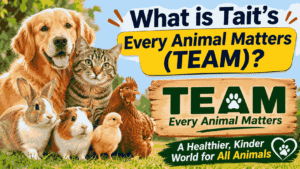
Tait’s Every Animal Matters is the working name of the Vernon A. Tait All-Animal Adoption, Preservation & Rescue Fund, a nonprofit based in Westbrook, Connecticut. Its registry listing gives its mission as helping with the medical treatment of cats, especially spaying and neutering.
Its best-known program is the TEAM Mobile Feline Spay/Neuter Clinic. Local news has reported that the clinic began operating on March 1, 1997. TEAM describes it as Connecticut’s first and only mobile spay, neuter, and vaccination clinic for cats, a self-description repeated in many local news items, so treat it as the organization’s claim. The clinic is staffed by a licensed veterinarian and veterinary technicians and travels to communities across the state, which is why Connecticut local papers and community groups regularly announce its stops.
How she is described in public sources
Reading the sources in order shows a role that grew with the organization. These are descriptions as reported, not a verified résumé.
| Source (type, approximate date) | How she is described |
|---|---|
| Newtown Bee (local news, early 2000s) | TEAM spokesperson |
| Animal People (trade paper, 2002) | TEAM coordinator |
| Connecticut Department of Agriculture bulletin (2010) | Named as the person who will continue TEAM’s work |
| NBC Bay Area report on FeralStat (undated) | Public relations director for FeralStat |
| The Day (New London, undated) | Executive Director of TEAM |
| Essex Savings Bank program (2016) | Representing TEAM at a community-grant announcement |
| FOX61 (about 2014) | Executive Director of TEAM |
| State working-group meeting lists (2019) | Attendee representing TEAM |
Two cautions follow from this table. First, some competitor pages state she became Executive Director in March 1997. The mobile unit did start that month, but the sources reviewed show her described as spokesperson and coordinator in the early years, so the exact start date of her Executive Director title is not established here. Second, “undated” entries are included because they show how she is introduced, not when.
Working with Dr. John A. Caltabiano and keeping TEAM running
TEAM’s mobile unit launched in 1997 under Dr. John A. Caltabiano, a Connecticut veterinarian and the organization’s president. Press and state notices from March 2010 reported his death and stated that TEAM’s work, along with FeralStat, would continue under Sicuranza. That continuity is the most significant fact in her public record: a specialized mobile clinic that outlived its founder and kept operating.
This is also why precision about her role matters. Veterinary staff perform the clinic’s procedures. An executive director’s contribution lies in what surrounds the surgery: fundraising, scheduling, outreach, relationships with community partners, and keeping a vehicle-based clinic funded and on the road.
Kalee Rogers Net Worth 2026: Career, Business, Income and Lifestyle
TEAM timeline: from registry listing to 225,000 cats
A timeline gives context that single-fact profiles miss. Dates below come from the sources reviewed; items marked “approx.” are inferred from how the report phrases elapsed time.
| Year | Milestone |
|---|---|
| 1993 | Registry lists the Vernon A. Tait fund (TEAM’s legal entity) with a 1993 ruling year |
| 1997 | Mobile Feline Unit begins operating (local news gives March 1, 1997) |
| 2002 | Trade press reports a $49 package and names Sicuranza as TEAM coordinator |
| Mid-2000s | Community partners such as Newtown’s SNAN begin sponsoring TEAM visits (first Newtown clinic in October 2006) |
| 2010 | News reports Dr. Caltabiano’s death and say TEAM’s work continues under Sicuranza |
| approx. 2014 | FOX61 reports 170,000+ procedures and an $80 fee |
| 2015 | Patch describes a $35 rebate for TNR caretakers |
| 2016 | TEAM takes part in a bank’s community investment program |
| 2019 | Attendee lists place TEAM at state animal population control working-group meetings |
| Present | TEAM reports 225,000+ cats sterilized and vaccinated |
How the TEAM Mobile Feline Spay/Neuter Clinic works
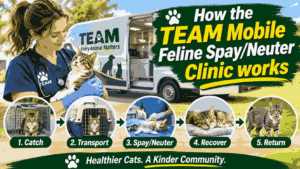
What is included. News coverage describes a package that includes a brief exam, vaccinations (rabies, distemper, and upper and lower respiratory infection), a nail trim, and ear mite treatment if needed. Initial services may require a follow-up booster visit.
Who can use it. Reports describe the clinic as available to Connecticut residents caring for domestic or feral cats, and do not describe an income test. Cats are generally accepted from 16 weeks of age. TEAM advocates trap-neuter-return (TNR), and feral cats are welcome; a national cat-advocacy directory lists this.
How to book. Appointments are required and fill up early. TEAM’s toll-free line is 888-367-8326 (888-FOR-TEAM), and its website is everyanimalmatters.org. Check the current schedule and requirements there, since stops and rules change.
What a clinic stop looks like. Local coverage of community clinic days describes a morning check-in, cats waiting in carriers or traps in a parking lot or park, and an onboard surgical suite that handles dozens of animals per stop. One Newtown event, for example, had volunteers caring for 38 kittens and cats as they waited their turn. Follow TEAM’s own instructions on preparing a cat for surgery rather than relying on general advice, since protocols differ by clinic.
What it costs. Fees have changed over the years: reports put the package at $49 in 2002 and $80 around 2014. Occasional community-sponsored events have further reduced the price, and a rebate for TNR caretakers was described in 2015. Treat all of these figures as historical and confirm current fees with TEAM. In a FOX61 report, Sicuranza said that private-clinic quotes for a spay or neuter can run $200 to $300 or more.
Read More Celab info: Trendcelenhub.com
Impact by the numbers
TEAM reports sterilizing and vaccinating more than 225,000 cats since 1997. Earlier press and organization materials show how that number has grown.
| Reported total | Source and timing |
|---|---|
| 170,000+ spays and neuters | FOX61, about 17 years into the program |
| 200,000+ cats spayed or neutered and vaccinated on board | Patch, “more than two decades” in |
| 220,000+ cats | TEAM letter to a community bank program |
| 225,000+ cats | TEAM’s current description |
These are the organization’s own cumulative counts, not independent audits. They are consistent with each other in direction and scale, which is reassuring, but a reader should still attribute them to TEAM.
Why mobile spay and neuter matters
Cats can reproduce quickly, and unneutered populations can grow faster than shelters and rescues can absorb. Spaying and neutering stops that cycle before litters exist, which is why high-volume programs are a standard tool in animal welfare. Mobile delivery adds access: instead of every caretaker finding transport and an affordable clinic, the clinic comes to the community.
Community cats raise a further problem. Caretakers managing outdoor colonies cannot easily book routine vet visits. TNR programs depend on affordable, high-volume sterilization, and TEAM’s clinic is built for exactly that. In a news report about feral cats on a naval submarine base, Sicuranza identified people who don’t spay or neuter, leaving cats outdoors and abandoning pets, as the source of such populations.
High Net Worth Insurance Marco Island | Luxury Home Protection
Mobile clinic vs. conventional veterinary office
| Factor | Mobile spay/neuter clinic | Conventional veterinary office |
|---|---|---|
| Access | Travels to towns across the state | Fixed location; caretaker must travel |
| Service focus | One defined package for cats | Full range of care for many species |
| Volume | High-volume, scheduled clinic days | Mixed with routine and emergency care |
| Feral cats | Accepted by TEAM’s program | Varies by practice |
| Limits | Scheduled stops; appointments fill early | Open for urgent and ongoing care |
The mobile model is best understood as a complement to veterinary hospitals, not a replacement. A cat with an illness or an emergency still needs a regular veterinarian.
TNR in plain terms
Trap-neuter-return means humanely trapping community cats, sterilizing and vaccinating them, and returning them to their outdoor home. Sterilization stops the colony from growing. TNR advocates argue this is more durable than removing cats, because new cats tend to move into the vacated territory, whereas a stable, sterilized colony does not reproduce. TNR works at scale only when affordable, high-volume surgery exists, which is the gap TEAM’s clinic is designed to fill.
Policy and community involvement
Her name also appears outside the clinic. Attendee lists from 2019 meetings of the Connecticut Department of Agriculture’s Animal Population Control Program working group show her attending on behalf of TEAM. TEAM has partnered with groups such as Newtown’s Spay & Neuter Association and The Animal Center to bring low-cost clinic days to towns, and in 2016 it was among the nonprofits at a bank’s community investment program. This web of partners, state programs and local donors is how a small nonprofit sustains a statewide service, and it is where the TEAM executive’s work is least visible and most important.
What is verified and what is not
| Claim | Status |
|---|---|
| Executive Director of TEAM | Supported by organization letter and multiple news reports |
| Associated with TEAM since the 1997 launch | Supported in press by 2001–2002 as spokesperson or coordinator |
| Executive Director since March 1997 | Not corroborated; competitor claim only |
| Earlier career in freelance writing, editing, and public relations | Reported by secondary sites; consistent with PR-type roles in press; not confirmed in primary sources |
| Education at specific universities | Secondary sites only; not confirmed |
| Age, birth date, family, net worth | Not publicly established; deliberately not covered |
Treat anything in the second half of this table as unconfirmed until a primary source supports it.
What TEAM’s model shows
Three practical points stand out. A narrowly defined mission (cats, spay/neuter, vaccination) is easier to sustain than a broad one. Delivery matters as much as medicine, because a clinic that is hard to reach does not reduce overpopulation. And long-run consistency compounds: the cumulative totals above come from many ordinary clinic days across more than two decades.
How to research a person like this responsibly
Start with documents tied to an organization (nonprofit registries, official letters, government meeting records), then news reports, and treat biography sites as leads rather than evidence. Beware sites that copy each other: repetition is not confirmation. Match identity on organization, place, and field, not on the name. And leave out private details (age, relatives, finances) unless a reliable source makes them relevant to public work.
Frequently asked questions about Donna Sicuranza
Who is Donna Sicuranza?
She is the Executive Director of Tait’s Every Animal Matters (TEAM), a Westbrook, Connecticut nonprofit that runs a mobile spay, neuter, and vaccination clinic for cats. She is best known for leading and speaking for that program.
Is Donna Sicuranza the same person as Donna Sicuranza Marconi?
In the sources reviewed, yes: both names refer to the TEAM Executive Director. Older press uses Donna Sicuranza, and a TEAM letter uses Donna Sicuranza Marconi. The reason for the difference is private and not documented.
What is Donna Sicuranza known for?
She is known for her work with TEAM’s mobile feline clinic, which operates in communities across Connecticut and has sterilized and vaccinated more than 225,000 cats since 1997. She is also quoted in news coverage on feral cats and affordable spay/neuter.
Is Donna Sicuranza a veterinarian?
Public sources describe her as a nonprofit leader and communicator, not as the veterinarian performing surgeries. Licensed veterinary staff perform the clinic’s veterinary work.
How many cats has TEAM helped?
TEAM reports that it has sterilized and vaccinated more than 225,000 cats since 1997. Earlier reports cited 170,000+, 200,000+, and 220,000+ as the total grew. These are organization-reported figures.
How can I book the TEAM mobile clinic?
Call 888-367-8326 (888-FOR-TEAM) or visit everyanimalmatters.org. Appointments are required, and the schedule and fees change, so confirm both before planning.
Does TEAM take feral cats?
Yes. TEAM advocates trap-neuter-return and has stated that feral cats are welcomed aboard its clinic. Cats are generally accepted from 16 weeks of age; check current requirements with TEAM.
What was Dr. John A. Caltabiano’s role?
He was the veterinarian and TEAM president who launched the mobile feline unit in 1997. Notices from 2010 reported his death and said TEAM’s work would continue under Sicuranza.
What is FeralStat?
FeralStat is a feline contraceptive concept Dr. Caltabiano was associated with, and Sicuranza was described in an NBC Bay Area report as its public relations director. This article does not assess its regulatory status.
Is there another Donna Sicuranza?
Yes, other people share the name. To avoid mixing them up, confirm the organization (TEAM), place (Westbrook, Connecticut), and field (feline welfare) before accepting any detail.
How old is Donna Sicuranza, and what is her net worth or family situation?
Her age, family, and finances are not publicly established in reliable sources, and this article does not speculate about them. Sites that publish exact figures rarely cite evidence.
Key takeaways
- Donna Sicuranza (also Donna Sicuranza Marconi) is the Executive Director of Tait’s Every Animal Matters in Westbrook, Connecticut.
- TEAM’s mobile feline clinic has operated since 1997 and reports sterilizing and vaccinating more than 225,000 cats.
- Her documented role has grown from spokesperson and coordinator to Executive Director, with continuity after TEAM’s founding veterinarian died in 2010.
- To book or ask about the clinic, call 888-367-8326 or visit everyanimalmatters.org; fees and schedules change.
- Treat education, earlier career dates, and similar claims from secondary sites as unconfirmed.
