

Type “GlobalUnpaid com” into a search bar and you will find two kinds of people. Some want to know what the website is. Others are owed money by a client or employer and hope the name means help is a click away.
Both groups deserve a straight answer, so this guide does two jobs. First, it explains what public reviews say about GlobalUnpaid com and how to verify any site that claims to chase debts. Second, it walks through how to recover an unpaid invoice from an overseas client: proving the debt, escalating in a sensible order, writing a demand, understanding late-payment interest, choosing between an agency, a lawyer, and arbitration, and knowing when to walk away.
Most overdue invoices do not fail in a courtroom. They fail in the first few weeks, in silence, while you politely wait and the client’s accounts team moves your invoice to the bottom of the pile. That part you can change.
One caution before we start. Laws differ by country, and the right move for a $ 500 invoice isn’t the right move for $ 50,000. Nothing here is legal advice. Where real money is at stake, confirm the details with a qualified lawyer in the relevant jurisdiction.
What GlobalUnpaid com Is (and What It Is Not)
Based on the public reviews and domain information available when this guide was written, GlobalUnpaid com is a multi-topic article website. Reviewers describe guide-style content across technology, finance, business, health, travel, education, real estate, and automotive subjects. None of the descriptions I reviewed show a claim form, a case system, a payout dashboard, or a licensed recovery operation.
That matters because the name points somewhere else. “Unpaid” suggests wages, invoices, and collections. “Global” suggests an international service. Put them together, and a freelancer chasing an overseas client will assume help is on offer. A domain name tells you what its owner chose, not what the site does.
A few details come up repeatedly in third-party reviews:
- Domain registration: reports give March 18, 2023, which is not necessarily the date publishing began. One review mentions older archived content, so the site’s true age is unclear.
- Ownership: reviewers say the operator and writers are not publicly named. Treat the owner as unconfirmed.
- Technical setup: reports describe a WordPress site with HTTPS behind Cloudflare. One technical check flagged missing security headers, a hardening gap, not evidence of anything malicious.
- Services: no evidence of wage claims, debt collection, or earning schemes.
Reviews of vague domain names also tend to copy one another, so repetition is not proof. Check anything important yourself, which is exactly what the next section helps you do.
<!– If you own or edit GlobalUnpaid com, replace this section with verified facts: legal entity, contact details, editorial policy, and exactly what the site does and does not offer. Do not leave claims you cannot document. –>
What this means if you are owed money
If you arrived hoping GlobalUnpaid com would collect a debt for you, the public evidence does not support that. Do not send contracts, ID, or bank details to any website expecting recovery help unless it names its legal entity, explains its fees in writing, and can be verified independently.
How to Verify Any Website or Recovery Service in Ten Minutes

You do not need technical skills. These checks work on GlobalUnpaid com and on any company that says it can recover your money.
- Look for a named company or person. A real recovery provider shows a registered business name, an address and people you can contact.
- Search the official business registry of the country the company claims to be based in. No registration, no deal.
- Check licensing. Debt collection is licensed or regulated in many countries. Ask which licence applies and look it up with the regulator.
- Run a WHOIS lookup to see when the domain was registered and through which registrar, and compare it with the history the company claims.
- Check the Wayback Machine to see what the site looked like in the past.
- Search the name with “complaint” and “scam”. Read what comes back with a critical eye, because review pages often copy each other.
- Paste the address into a safe-browsing checker or a scanner such as VirusTotal. A clean result is reassuring, not a guarantee.
- Read the contract. Look for fees, expenses, who holds your money, and who can settle on your behalf.
- Check the address bar before typing into any form. Look-alike domains are common, and a similar name with a different extension isn’t automatically the same publisher.
- Walk away from upfront “recovery fees” paid to anyone you cannot identify.
Unpaid Wages vs Unpaid Invoices: Pick the Right Route
Search results for this keyword mix two very different problems, and the routes are not the same.
You are an employee owed pay. Go to your country’s official labour body, not a private website.
- United States: the Department of Labor’s Wage and Hour Division explains federal wage rules and how to file a complaint. Many states also run their own labour departments.
- United Kingdom: Acas offers free guidance on unpaid wages, and HM Revenue and Customs handles minimum wage complaints.
- Australia: The Fair Work Ombudsman handles underpayment and unpaid-wage enquiries.
- Elsewhere: search for your country’s labour ministry or inspectorate by name and make sure the address is an official government domain.
Keep your contract or offer letter, payslips or timesheets, bank statements and written messages about the pay owed. A dated paper trail strengthens any complaint.
You are a freelancer, contractor or business owed an invoice. That is a commercial debt, and it follows the route in the rest of this guide: evidence, reminders, formal demand, then agency, lawyer or arbitration.
Quick10sec.com Review 2026: What It Is, How It Works & Is It Worth It?
What International Debt Recovery Really Involves
Domestic collection is awkward enough. Cross-border recovery adds three layers of friction.
Jurisdiction. Which country’s courts can hear the case, and which country’s law governs the contract? If your agreement says nothing, you may spend more arguing about where to sue than about the debt.
Enforcement. Winning a judgment is one thing. Collecting on it in a country where the debtor holds assets is another. Some countries enforce foreign court judgments readily and others barely at all. Arbitration awards travel better, which is why the New York Convention comes up later.
Cost against value. Lawyers, translators, court fees and agency commissions all take their share. A debt of a few hundred dollars can cost more to pursue formally than it is worth. That is hard to hear when you are angry, but it is true.
Insolvency is the fourth risk, and it hides in plain sight. A debtor who is about to fail pays the loudest creditor first and the rest last, or never. For that reason alone, speed and persistence matter.
Honestly, the best recovery strategy for most international invoices is the cheapest one that works: fast, firm, written communication, started early. Formal proceedings are the last stop, not the first.
Step 1: Confirm the Debt and Gather Proof
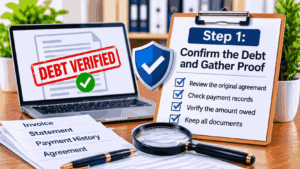
Before you chase anyone, check that you are chasing a debt and not a dispute. “We never received this” and “we won’t pay” are two different problems.
Open your own records first. Was the invoice correct? Were the goods delivered or the work accepted? Did the amount match the quote or purchase order? Was it sent to the right person at the right legal entity?
A hypothetical example: a supplier chases a 12,000 dollar invoice for two months before discovering it was addressed to a subsidiary that had been dissolved. The client’s real company had never seen it. Mistakes like this are common, and theyare easy to fix.
Evidence checklist
Keep copies in one folder, stored somewhere other than your email:
- The signed contract, quote or purchase order, including payment terms
- The invoice and proof it was sent (dated email, courier receipt, portal confirmation)
- Proof of delivery or acceptance: signed delivery note, shipping documents, approval emails, project sign-off
- All correspondence about the work and about payment
- Any acknowledgment of the debt, even a casual “we will pay next week”
- Records of earlier payments, which show the client has paid before and knows the process
An acknowledgment of the debt matters more than people expect. In some legal systems, it can affect time limits, and it makes a later “we dispute this” harder to sustain.
If the client disputes the invoice, deal with the dispute first. Ask for the specific objection in writing, answer it point by point, and offer a fair adjustment if part of the complaint is legitimate. Chasing a disputed invoice as though it were simple non-payment is how people end up in a long argument and lose any chance of settlement.
Magnexusbuzz.com Review (2026): Is It Legit, Who Runs It
Reminders and the Escalation Ladder
An escalation ladder is a planned sequence of increasingly firm contacts with fixed order and fixed gaps. Without one, you chase when you are angry and go quiet when you are tired, and clients notice.
The timings below are my own practical suggestion, not a legal rule. Adjust them to your payment terms and the debt size.
Escalation timeline
- Due date or day 1 after: a friendly payment reminder with the invoice attached again and a direct question: “Can you confirm the payment date?”
- Around day 7: a shorter second reminder naming the amount and asking for a specific date. Try a call if you have a contact. A voice is harder to ignore than an email.
- Around day 14 to 21: a formal demand letter with a clear deadline and stated next step.
- Around day 30 to 45: the decision point. Agency, lawyer, mediation, arbitration, or write-off, depending on size, evidence, and the debtor’s country.
- Throughout: pause new work and new shipments. Continuing to supply a client who has stopped paying is the most expensive mistake in credit control.
Look, a polite reminder with no deadline is a request, not a demand. Requests get ignored. A deadline gives the client something to respond to and gives you something to point at later.
Tone should escalate with the ladder. Early messages assume an honest oversight. Later ones assume nothing and state facts. Never threaten something you will not do. If you announce legal action and then do nothing, you have taught the client that your deadlines are decorative.
Send reminders to the person who can authorize payment. Chasing a project manager who loved your work but can’t control accounts payable is a pleasant way to waste a month. Ask for the finance contact by name.
Writing a Demand Letter That Works
A demand letter is a formal written notice that a specific amount is overdue and that you will take stated steps if it is not paid by a stated date. It does not need legal language. It needs precision.
A good one includes:
- Your details and the debtor’s full legal name and address
- The invoice number, date, amount and currency
- A short statement of what the invoice covers and the agreement it falls under
- The original due date and how many days overdue it is
- Any interest or fixed compensation you are claiming, with the basis (contract clause or statute)
- A specific deadline, usually 7 to 14 days from the letter
- What you will do next if payment does not arrive
- Payment instructions with bank details and a reference
Send it in a way that proves delivery: email with read receipt plus tracked courier, or whatever your contract says about formal notices. Some agreements require notices to go to a specific address in a specific form, and a letter sent to the wrong place may be argued not to count.
Demand letter template
Adapt the wording to your situation and your governing law. Have a lawyer review it if the amount is significant.
Subject: Formal demand for payment: Invoice [number], [amount and currency]
[Date]
To: [Debtor legal name], [address]
We refer to invoice [number] dated [date] for [amount and currency], issued for [short description of goods or services] under [contract / purchase order reference]. The invoice fell due on [due date] and remains unpaid. Copies of the invoice, the agreement and proof of delivery are attached.
We require payment of [amount, plus interest of [rate/basis] and [fixed compensation, if claimed]] in full by [deadline date, 7 to 14 days]. Payment should be made to [bank details] quoting reference [reference].
If payment is not received by that date, we will [state your genuine next step, for example refer the matter to a lawyer or collection agency and pursue recovery of the debt together with interest and costs as permitted by law].
If you dispute any part of this invoice, please tell us in writing, with reasons, before the deadline.
[Name, position, contact details]
Keep it to one page. If a lawyer reads it later, they should be able to pick it up and use it as an exhibit.
One opinion, since you will meet advice that says otherwise: do not threaten to “report them to credit agencies” or “damage their reputation” unless you genuinely can and the law allows it. Threats you cannot back up, or that cross legal lines, can backfire. State the real next step and stop.
A short letter on a lawyer’s letterhead carries extra weight with some debtors, particularly medium and large companies. It also costs money. For mid-sized invoices, it is often the best-value step before anything formal.
Amandeuce and InflightXperience: Who Is Behind the Flight Videos?
Late Payment Interest and Legal Rights
Many creditors do not realize they may be entitled to interest, and sometimes fixed compensation, on top of the invoice. Whether you are depends on the contract and the governing law.
Contract first. If your agreement sets a late payment rate, that is usually the starting point. If it is silent, the governing law may fill the gap.
In the EU, the Late Payment Directive (2011/7/EU) covers business-to-business and public-authority payments. In broad terms: a default payment period of 30 days, up to 60 days if expressly agreed and not grossly unfair, statutory interest set at 8 percentage points above the European Central Bank reference rate unless the contract says otherwise, a minimum fixed sum of 40 euros per late invoice, and reasonable recovery costs. Each member state implements it through national law, so details depend on the debtor’s country.
The European Commission proposed replacing the Directive with a Regulation that would cap payment terms at 30 days. Reports indicate the proposal has stalled in the Council, and as far as I could verify the Directive remains the operative law. Check the current position before you rely on either.
In the UK, the Late Payment of Commercial Debts (Interest) Act 1998 lets eligible business creditors claim statutory interest at 8 percent above the Bank of England base rate, fixed sums that scale with the size of the debt (40, 70 or 100 pounds), and reasonable recovery costs.
In the US, there is no single federal late payment interest rule for business debts. It depends on your contract and state law. The Fair Debt Collection Practices Act (FDCPA) is often cited here, but it generally covers consumer debts, not commercial invoices between businesses.
Elsewhere, rules vary widely. Some countries have statutory interest regimes, some leave it to the contract, and some cap interest. Ask a local lawyer or check guidance from the relevant chamber of commerce or ministry.
Limitation periods and time-barred debts
How long you have to bring a claim varies by country and by claim type. A time-barred debt can become unenforceable in court. UNCITRAL has produced a convention on limitation periods in the international sale of goods, but it applies only where the countries involved are parties and the transaction falls within scope. In practice, check the limitation period under the governing law early. Don’t leave an old invoice in a drawer and assume it will stay.
Collection Agency vs Lawyer vs Arbitration
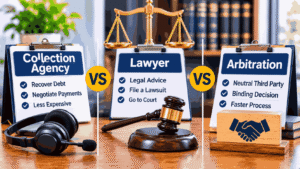
By day 30 to 45, you need to decide. The options do different jobs.
A collection agency specializes in contacting debtors, negotiating and pursuing payment, often without court. A good international agency has local presence or partners in the debtor’s country and understands local business customs. Its strengths are persistence and low upfront cost. Its weakness is that it cannot force payment. If the debtor ignores it and the agency will not refer the case to a lawyer, you may be left with nothing.
A debt collection lawyer can send formal letters, start proceedings, and represent you in court. A lawyer is the right call when the debt is large, the debtor has reachable assets, the evidence is solid, or the debtor is disputing the claim. Lawyers charge by the hour, so costs are less predictable.
A rough guide: if the debtor is simply ignoring you, an agency’s persistence may be enough. If the debtor is arguing, you probably need a lawyer. Plenty of people hire the wrong one for the situation.
A hypothetical case: a $ 1,800 consulting invoice owed by a small company overseas. A local lawyer might charge a large share of that just to review the file, while a commission-based agency takes a percentage of whatever it recovers and nothing if it recovers nothing. At that size the agency looks more sensible, provided you have verified it and understood its fee terms.
Small claims vs arbitration
Small claims procedures exist in many countries for lower-value disputes and aim to be cheaper and simpler. Cross-border, you usually have to bring the case where the debtor is, in that country’s language and under its rules. Within the EU, cross-border procedures may help with claims between member states, such as the European Small Claims Procedure and the European Order for Payment. They have thresholds and scope limits, so check whether they fit your case. Outside such frameworks, small claims abroad is often impractical for a distant creditor.
Arbitration is a private process where an arbitrator or panel decides the dispute, usually under rules chosen in the contract, such as the International Chamber of Commerce (ICC) Arbitration Rules. It requires an arbitration clause or a later agreement to arbitrate. Its big advantage is enforcement: under the New York Convention on the Recognition and Enforcement of Foreign Arbitral Awards, courts in many member countries can recognize and enforce awards, subject to limited grounds for refusal. Its big drawback is cost. For smaller invoices, institutional arbitration can be disproportionate to the debt.
Mediation sits alongside both. It is a facilitated negotiation that can produce a settlement faster and cheaper than either route. It works only if the debtor wants to resolve things, but where there is a genuine dispute and not plain non-payment, it is often worth proposing.
BacktoFrontShow Pricing 2026: Plans, Real Costs and Whether It Is Worth It
Payment Plans and Settlements
Sometimes the realistic outcome is not full, immediate payment. A debtor in cash-flow trouble may agree to a payment plan, and a payment plan you actually collect on beats a judgment you cannot enforce.
If you agree to one, put it in writing: amounts, dates, what happens on a missed instalment, and that the full balance becomes due on default. Consider asking for an acknowledgment of the full debt in the same document. For a discounted lump-sum settlement, make sure the document states that it settles the claim only once the agreed amount is received in cleared funds.
Don’t accept vague promises on a phone call and then stand down your escalation. If the debtor keeps the plan, you have been paid. If they do not, your next step is already scheduled.
Fee Models Explained
Fees are where many readers feel burned, so understand the structures before signing anything.
No-win-no-fee vs fixed fee
No-win-no-fee (success-based). The agency or lawyer takes a percentage of what is recovered and charges nothing for its time if nothing is recovered. It removes upfront risk and aligns incentives. The trade-offs: the percentage can be significant, providers tend to be selective about which cases they accept, and “no fee” sometimes means no fee for their time while you still pay court costs and third-party expenses. Read what counts as a “win.”
Fixed fee. You pay a set price for defined work, such as a letter before action or a case assessment. The cost is predictable, but you pay whether or not you recover anything.
Hourly rates. Common with lawyers. Flexible but hard to budget. Ask for an estimate and what would cause it to rise.
Hybrid models. A small upfront fee plus a lower success percentage. Read the fine print, especially on anything “refundable if we fail.”
Whatever the structure, get it in writing: what you pay and when, what triggers extra charges, who pays expenses, whether the provider can settle without your approval, and how recovered money reaches you. If the provider collects funds on your behalf, ask how and when they pass them on.
I would not trust any provider who will not explain fees plainly before you sign. Vague fees are the clearest warning sign in this industry.
Is It Worth Chasing? A Decision Framework
Recovery is a business decision. Run through five questions before you spend a cent.
- How big is the debt? Compare it with realistic costs, not best-case costs.
- How strong is your evidence? A signed contract and proof of delivery change everything. A handshake and a chat thread do not.
- Can the debtor pay? A solvent company with assets is a different proposition from a shell or an insolvent business.
- Can you reach them? Consider the debtor’s country, the governing law, and whether judgments or awards can be enforced there.
- What is your time and stress worth? Chasing costs energy that would otherwise earn money.
A hypothetical illustration: a 3,000-dollar invoice, solid evidence, a debtor in a country with workable enforcement. Suppose a provider quotes 20 percent on success. If the odds of recovery are decent, the expected net is positive. Now change one thing: the debtor appears insolvent. The same quote now buys you a small chance of a small recovery, and a write-off plus tighter terms for future clients may be the better move.
Writing off a debt is not failure. It is arithmetic. A tax adviser can tell you whether a write-off has tax consequences in your country.
Choosing an option by invoice size and country
This table is a general comparison, not a quote. Real costs and timelines vary by country, provider and case.
| Option | Best for | Typical speed | Relative cost | Main risk |
|---|---|---|---|---|
| DIY reminders | Small or recent debts, honest oversights | Days to weeks | Very low | Ignored if there is no deadline or escalation |
| Demand letter | Debts past the reminder stage, clear evidence | 1 to 3 weeks | Low (higher if sent by a lawyer) | Ignored if you do not follow through |
| Collection agency | Small to mid-sized debts where the debtor is ignoring you | Weeks to months | Low upfront, success-based commission common | Limited power if the debtor refuses; fee terms may be unclear |
| Lawyer | Larger or disputed debts, solid evidence, reachable assets | Months | Medium to high | Cost can exceed recovery; enforcement abroad may be hard |
| Arbitration or court | Large debts, contracts with arbitration clauses, serious disputes | Months to years | High | Time and cost; a favorable ruling still has to be enforced |
| Factoring or trade credit insurance | Prevention and cash flow before a problem starts | Varies | Ongoing fees or premiums | Must be arranged in advance; no cure for an existing bad debt |
Rules of thumb:
- Small amounts: reminders, a demand letter and, if needed, a commission-based agency. Do not spend a thousand dollars chasing five hundred.
- Medium amounts: a lawyer’s letter is often best value, then agency or lawyer depending on the response.
- Large amounts: speak to a lawyer early, before the debtor can move assets or become insolvent.
- Country: the debtor’s location matters as much as the amount. Reliable courts and treaty links are a very different starting point from slow or uncertain enforcement.
Factoring and trade credit insurance are tools for the next invoice, not this one. Factoring means selling receivables to a finance company for immediate cash, usually for a fee. Trade credit insurance covers part of the risk that a buyer will not pay, but it generally has to be in place before the loss and comes with conditions you must meet. Neither rescues an invoice that has already gone bad.
How to Spot Recovery Scams
Anyone with an unpaid invoice is a target. People who are stressed and out of pocket will pay for hope, and some operators know it.
Warning signs:
- Upfront fees with big promises. Nobody can guarantee recovery. Anyone who does is selling.
- Pressure to decide today. A legitimate provider lets you read the terms.
- No verifiable identity. No registered company details, no address, no named people, only a webmail address.
- Vague or shifting fees. If the cost is “discussed later,” walk away.
- Requests to pay to “unlock” recovered funds. A classic advance-fee pattern. You should not have to pay to receive your own money.
- Payment to personal accounts or untraceable methods.
- Funds routed through the provider with no clear process for passing them on to you.
A hypothetical pattern worth recognizing: a stranger contacts you about an old invoice you never mentioned publicly, claims to have “located” the debtor, and asks for a processing fee. The unsolicited approach is the tell. Real providers rarely know about your private debts.
Run the ten-minute checks from earlier in this guide. Your national consumer protection agency, such as the US Federal Trade Commission, publishes material on recognizing recovery scams.
Readers also type a direct question into search engines: is GlobalUnpaid com legit? Public reviews describe a working content blog with an unnamed publisher, and none that I reviewed show it taking payments for recovery. I cannot vouch for any company on your behalf, and a web page should not either. Apply the same checks to every site and every provider, and do not share documents or send money to anyone you have not verified.
Prevention: Contracts and Payment Terms

The cheapest unpaid invoice is the one that never goes unpaid. A few habits do more than any recovery service.
Put payment terms in writing and keep them short. Specify the due date, currency, bank details, and what happens if payment is late, including the interest rate or at least a statement that statutory interest and recovery costs apply where the law allows.
Choose the governing law and dispute forum deliberately. A contract that names the law, the courts or an arbitration institution saves months of argument if things go wrong.
Take a deposit or milestone payments. For new overseas clients, ask for part upfront. A client who refuses a deposit is telling you something.
Check who you are dealing with. Confirm the client’s legal entity, registration, and address. Run a credit check on larger accounts. Ask corporate clients for a purchase order.
For bigger deals, use payment security. A letter of credit, often governed by the ICC’s UCP 600, shifts payment risk to a bank. Escrow holds funds until agreed conditions are met. Trade credit insurance can cover part of the risk across a portfolio of buyers. All cost money and add paperwork, so they suit larger or riskier transactions.
Use shipping terms properly. Incoterms, published by the ICC, define who is responsible for what in delivering goods and help you prove delivery. Name the current edition in your contract.
Watch your own numbers. Track days sales outstanding (DSO), the average time it takes you to collect after a sale. A creeping DSO shows a collection problem building long before any single invoice becomes a crisis.
A hypothetical clause that saves time: “Invoices are payable within 14 days of the invoice date. Late payments incur interest at [rate] per month and reasonable costs of recovery. Disputes must be raised in writing within 7 days of receipt.” The last sentence is the useful one, because it forces objections into the open early instead of after 60 days of silence. Have a lawyer adapt wording like this to your jurisdiction.
Adswynk com Review 2026: What It Is, Why Reviews Disagree, and How to Verify It
Common Mistakes
Waiting too long. Memories fade, contacts leave, companies fold, and limitation periods run.
Chasing without a deadline. The most common error, and the cheapest to fix.
Continuing to work or ship. Every new delivery to a non-paying client increases your exposure.
Mixing up a dispute and a debt. If there is a genuine complaint, deal with it. If you ignore it, the client has a reason not to pay and a story to tell.
Sending angry emails. They feel good, and they come back to haunt you. Everything you write may be shown to a lawyer, an arbitrator, or a judge.
Skipping the paper trail. Calls and chat messages are easy to deny. Follow every call with an email that summarizes what was agreed.
Paying a “recovery fee” upfront to someone you have not verified.
Ignoring the cost-benefit math. Pride is expensive. Decide in advance how much you will spend to recover.
Assuming one country’s law applies everywhere. Advice written for US consumers does not help you collect from a company in Germany.
Laws and Frameworks Worth Knowing
This is a map, not a manual. Check each item against the countries involved in your case.
- EU Late Payment Directive (2011/7/EU): the EU framework for payment periods, interest and fixed compensation in commercial transactions, implemented through national laws. A proposed replacement Regulation has been discussed since 2023; verify its current status.
- UK Late Payment of Commercial Debts (Interest) Act 1998: statutory interest and fixed sums for eligible business debts.
- FDCPA (US): federal law on debt collection practices, aimed at consumer debt and generally not commercial invoices.
- New York Convention (1958): the main treaty for recognizing and enforcing foreign arbitral awards across its many member states.
- UNCITRAL texts: model laws and conventions on international trade, including arbitration and limitation periods. Whether they apply depends on whether the countries involved have adopted them.
- ICC rules and publications: arbitration and mediation rules, Incoterms for delivery terms and UCP 600 for letters of credit. Contractual tools that apply only if you choose them.
- Local small-claims and civil procedure rules: the courts where the debtor is based have their own thresholds, forms, and time limits.
Laws change. Treat every reference in a general article, including this one, as a starting point for a conversation with a qualified lawyer, not the final word.
FAQs
What is GlobalUnpaid com?
Public reviews describe GlobalUnpaid com as a multi-topic content website covering subjects such as technology, finance, health and travel. They do not describe it as a wage, invoice or debt recovery service, and the operator is not publicly named. Check the live site and verify any claim before sharing information.
Does GlobalUnpaid com help recover unpaid invoices or wages?
Reviews found no claim form, case system or recovery service on the site. If you are an employee owed pay, contact your national labour authority. If you are a freelancer or business owed an invoice, follow the escalation steps in this guide and consider a verified lawyer or agency.
Is GlobalUnpaid com legit or a scam?
Reviewers describe a working blog with an unnamed publisher, and none reported it charging for recovery. That is not the same as a guarantee. Treat it like any anonymous publication: read it with care, verify important claims elsewhere, and share no personal or payment details.
How do I recover an unpaid invoice from another country?
Confirm the debt and gather proof, send firm reminders, then a formal demand letter with a deadline. If the client still does not pay, choose between an agency, a lawyer, mediation or arbitration based on the amount, evidence and where the debtor’s assets are. Start early.
Honestly, most cases are won or lost in the first month. Your paperwork and your follow-up speed matter more than clever tactics later.
What is the difference between a collection agency and a lawyer?
An agency focuses on contacting and pressuring the debtor, often for a commission and without court. A lawyer can send formal legal letters, start proceedings and represent you in court, usually for time-based or fixed fees. Agencies suit ignored invoices. Lawyers suit disputes and larger sums.
How long do I have to claim an unpaid invoice?
It depends on the governing law, the type of claim and where you sue. Limitation periods vary widely, and a time-barred debt may be unenforceable in court. Check the rule for your contract early, ideally with a lawyer.
Do not guess here. This is the one question where waiting can cost you the whole claim.
Can I charge late payment interest?
Often yes, but it depends on your contract and the governing law. The EU and UK have statutory interest and fixed compensation for business debts. Elsewhere, you may need a contract clause. Check the debtor’s country and state the claim clearly in your demand letter.
What is a demand letter?
A demand letter is a formal written notice that a specific amount is overdue, with a payment deadline and a stated next step. It records your claim, shows you acted reasonably and often precedes legal action. A reminder with no deadline is a request. A demand letter has one.
How much does debt recovery cost?
There is no standard price. Costs depend on the amount, the country, the provider and the route: commission-based agencies, fixed-fee letters, hourly lawyers, or arbitration with institutional and arbitrator fees. Get fees in writing, including expenses, and compare them with what you can realistically recover.
I would not treat any cost figure on a web page, including this one, as a quote.
What is no-win-no-fee collection?
The provider takes a percentage of what it recovers and charges nothing for its time if it recovers nothing. It cuts upfront risk, but check the percentage, what counts as a recovery, whether you still pay court or third-party costs, and whether the provider can decline weak cases.
How do I know a recovery service is legitimate?
Verify the company in an official registry, check licensing where required, search for complaints, read the contract and ask who will handle your case. Be wary of upfront fees, guaranteed results, pressure to sign quickly, vague fees and requests to send money to receive your funds.
When is it not worth chasing a debt?
When the likely cost of recovery, in money, time and stress, exceeds what you can realistically collect, or when the debtor is insolvent or unreachable. Weigh the amount, your evidence and the debtor’s country. A write-off combined with better prevention can be the smartest decision.
There is no shame in walking away from a bad debt. There is plenty of regret in throwing good money after it.
What is the escalation process for unpaid invoices?
A typical ladder runs from a friendly reminder at the due date, to a firmer reminder with a payment date, to a formal demand letter with a deadline, then a choice between an agency, a lawyer, mediation or arbitration. Stop supplying the client along the way and keep a written record.
Who owns GlobalUnpaid com, and when was it registered?
Public domain reports give March 18, 2023 as the registration date, though that may not match when publishing began. Reviewers say the owner and editorial team are not publicly confirmed. Check a WHOIS lookup and the site’s About and Contact pages.
Final Summary and Next Step
A search for “GlobalUnpaid com” leads many people to the wrong place. Public reviews describe a content blog, not a recovery service, and its publisher is not clearly named. If you are owed money, the answer is a process, not a website: prove the debt, set deadlines, escalate in a planned order, pick the route that fits the amount and the country, and be willing to walk away when the numbers say so. Then fix your contracts, deposits and payment terms so the next invoice does not repeat the story.
